If you're trying to figure out whether your home has mold, you've probably come across mold detection dogs. They're becoming more common, and every so often someone calls us asking whether they should book a dog before scheduling an inspection.
The short answer is that they're different tools designed to answer different questions.
In our opinion, most homeowners should start with a licensed mold inspection. That doesn't mean mold detection dogs aren't valuable. In fact, we've recommended them ourselves in certain situations. It's just that they usually make the most sense after a thorough inspection has already been done, not before.
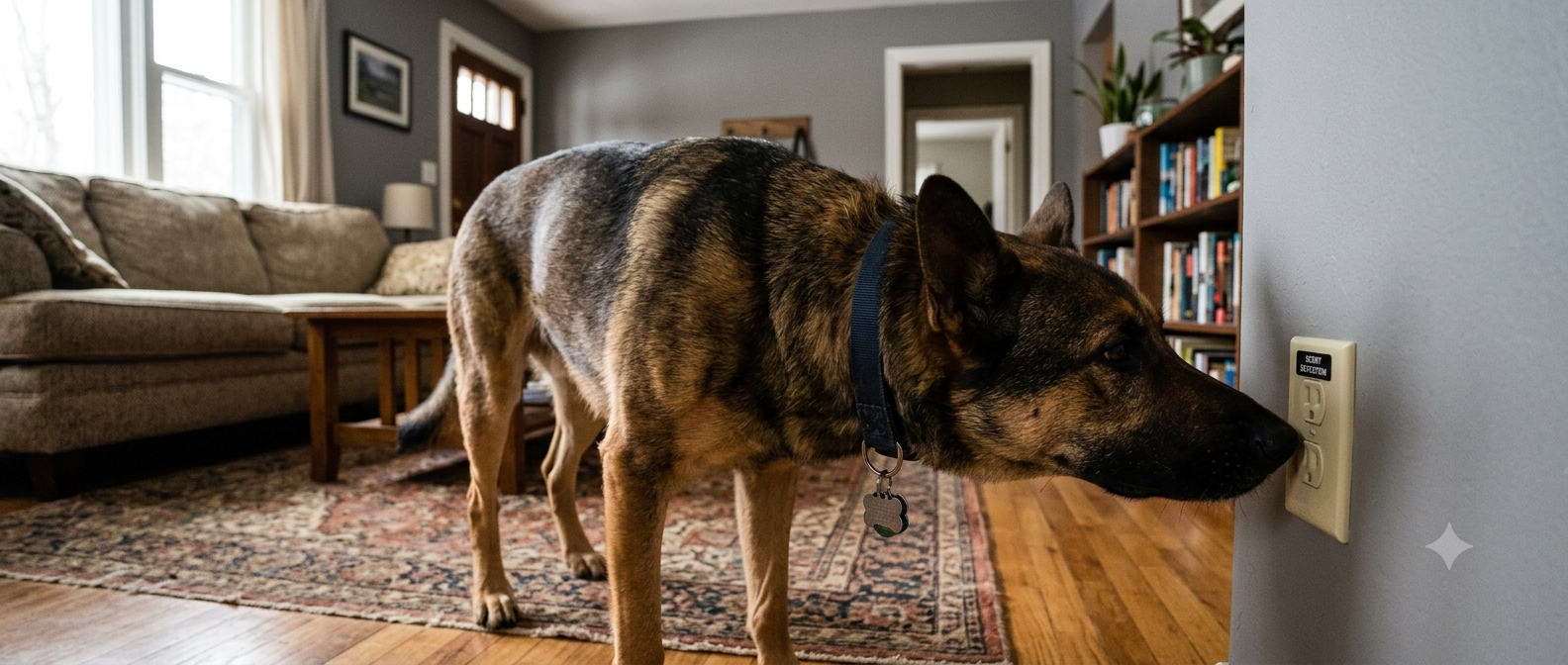
A mold detection dog is trained to detect odors associated with mold and alert its handler to areas that may deserve further investigation.
Think of it as another investigative tool. An alert doesn't necessarily mean mold is growing exactly where the dog sits or scratches. Odors can travel through walls, ceiling cavities, ductwork and other concealed spaces. The dog's job is to provide clues, not diagnose the problem.
Like any specialty service, the quality of mold detection dogs can vary considerably. Some handlers have years of experience, ongoing training and excellent track records. Others may be much less experienced. Just because a dog alerts doesn't automatically mean walls should start coming down.
A licensed mold inspector is looking at the entire building, not just one location.
Our goal is to answer questions like:
A proper inspection usually includes a detailed visual assessment, moisture meter readings, thermal imaging, inspection of accessible HVAC components, attic evaluation where accessible, and, when appropriate, air samples, surface samples or ERMI testing.
We're trying to understand the building as a whole rather than simply identify one area that deserves more investigation.
For most homes, a comprehensive inspection is simply the most efficient place to start.
We're already looking throughout the house, including places a mold detection dog can't evaluate. We inspect attics, HVAC systems, plumbing areas, window assemblies, visible water damage and building conditions that may have allowed mold to develop.
Many times, the inspection identifies the source without needing anything further. We find a moldy HVAC plenum that's been distributing spores throughout the home, a window crack that's been allowing rainwater into the wall cavity over time, or another hidden moisture source that explains exactly why mold developed.
If that's the case, you've saved yourself the cost of hiring both a mold detection dog and a mold inspector.
Budget is another practical consideration. A quality mold detection dog costs $1,200+, and in most situations you'll still need a licensed mold inspector afterwards to determine what's actually happening, perform testing if needed, and provide recommendations. Starting with an inspection often answers the questions you're trying to solve without adding another step.
This is where we think mold detection dogs really shine. Occasionally we inspect a home where everything appears normal. The visual inspection doesn't identify an obvious source. Moisture readings are normal. Air samples don't provide a clear answer. The HVAC inspection looks good. Yet something still doesn't make sense.
Perhaps the homeowner has physician-confirmed mycotoxin exposure that improves when they're away from the house. Maybe the ERMI suggests the home has an elevated mold burden, but despite a thorough inspection we still haven't found where it's coming from. Those are frustrating cases.
Rather than randomly opening walls throughout the house, a mold detection dog may provide the next clue that helps narrow down the search. We've recommended mold detection dogs in exactly these situations because they can sometimes identify hidden areas that deserve another look.
You'll also find companies that begin with a mold detection dog and then have an inspector investigate the areas where the dog alerts. There's nothing inherently wrong with that approach. However, we generally prefer starting with a comprehensive inspection because we're already evaluating the entire house, including areas a dog cannot assess. If the inspection still leaves unanswered questions, a mold detection dog can provide another valuable layer of information.
Like most investigative tools, mold detection dogs aren't perfect. We've heard stories where mold detection dogs identified hidden mold that multiple experienced inspectors had missed because it was concealed inside inaccessible building cavities. In situations like that, they can be incredibly valuable.
We've also heard the opposite.
There are reports of remediation companies tearing out entire bathrooms because a dog alerted, only to discover there wasn't hidden mold there after all.
We've also been in homes where the homeowner hired only a mold detection dog before anyone performed a proper inspection. During our inspection, we found visible mold growth in other parts of the home that the dog hadn't alerted to. That doesn't necessarily mean the dog "missed" the mold. Dogs are trained to detect odors, and there are many reasons they may alert to one area but not another. It simply reinforces that a mold detection dog should not be viewed as a substitute for a comprehensive inspection.
Another interesting example we've heard is dogs repeatedly alerting to wicker furniture, baskets, and other natural materials. We don't know exactly why in every case, but it highlights why a dog's alert should always be interpreted in context rather than assumed to be definitive evidence of hidden mold inside the building.
That's why we don't think a dog's alert should ever be viewed as the final answer. It should be treated as another piece of information that needs to be interpreted alongside the building inspection, moisture findings, testing results and the home's history.
In our opinion, no.
A mold detection dog cannot:
Likewise, an inspector isn't infallible either. Hidden problems can be difficult to locate, especially when there's no visible evidence or moisture source. That's why we see mold detection dogs as another tool in the toolbox, not a replacement for a thorough inspection.
For most homeowners, we'd recommend starting with a licensed mold inspector.
A comprehensive inspection often identifies the problem without needing anything further, and if additional investigation is necessary, the inspection helps determine the smartest next step.
If the inspection is thorough but the evidence still points toward the home despite no obvious source being found, that's when we may suggest bringing in a reputable mold detection dog. At that point, the dog isn't replacing the inspection. It's building on it.
Our goal isn't to prove one method is better than the other. It's to use the right tools, in the right order, to solve the problem as efficiently as possible.
Well-trained mold detection dogs can be very effective at identifying odors associated with mold, and we've heard of cases where they found hidden mold that multiple inspectors had missed. Like any investigative tool, however, the quality of the dog and handler matters, and their findings should always be interpreted alongside a proper building inspection. A dog's alert should point the investigation in a direction, not be treated as the final diagnosis.
No. A mold detection dog can provide valuable clues, but it cannot inspect the building, identify moisture sources, inspect the HVAC system or attic, perform moisture mapping, collect samples, or determine what remediation is actually needed.
You certainly can, but for many homeowners it comes down to budget. A mold detection dog is often an additional $1,000 or more, and you'll usually still need a licensed mold inspector afterwards to determine what the dog found, why it's there, and whether remediation is actually necessary. Starting with a comprehensive inspection often answers those questions without needing the additional expense.
We usually recommend considering one after a thorough inspection if the findings still don't explain what's happening. For example, if the inspection is unremarkable but the homeowner has physician-confirmed mycotoxin exposure, symptoms that improve away from the home, or an ERMI suggesting the house is the likely source, a mold detection dog can sometimes provide the next clue that helps focus further investigation.
Yes. We've been called to homes where a mold detection dog had already been through, yet we found visible mold growth elsewhere in the home that hadn't been identified. We've also heard of dogs locating hidden mold that inspectors missed. That's why we don't see it as an either-or decision. Both the inspector and the dog have strengths and limitations, and the best results often come from using each where they're most valuable.

.svg)


Texas Department of Licensing and Regulation (TDLR)
Mold Assessment Company: #ACO1327 Exp 09/28
Mold Assessment Consultant: #MAC2207 Exp 11/27
TDLR Consumer Mold Information Sheet
House Of Thyme ® 2026. All Right Reserved.