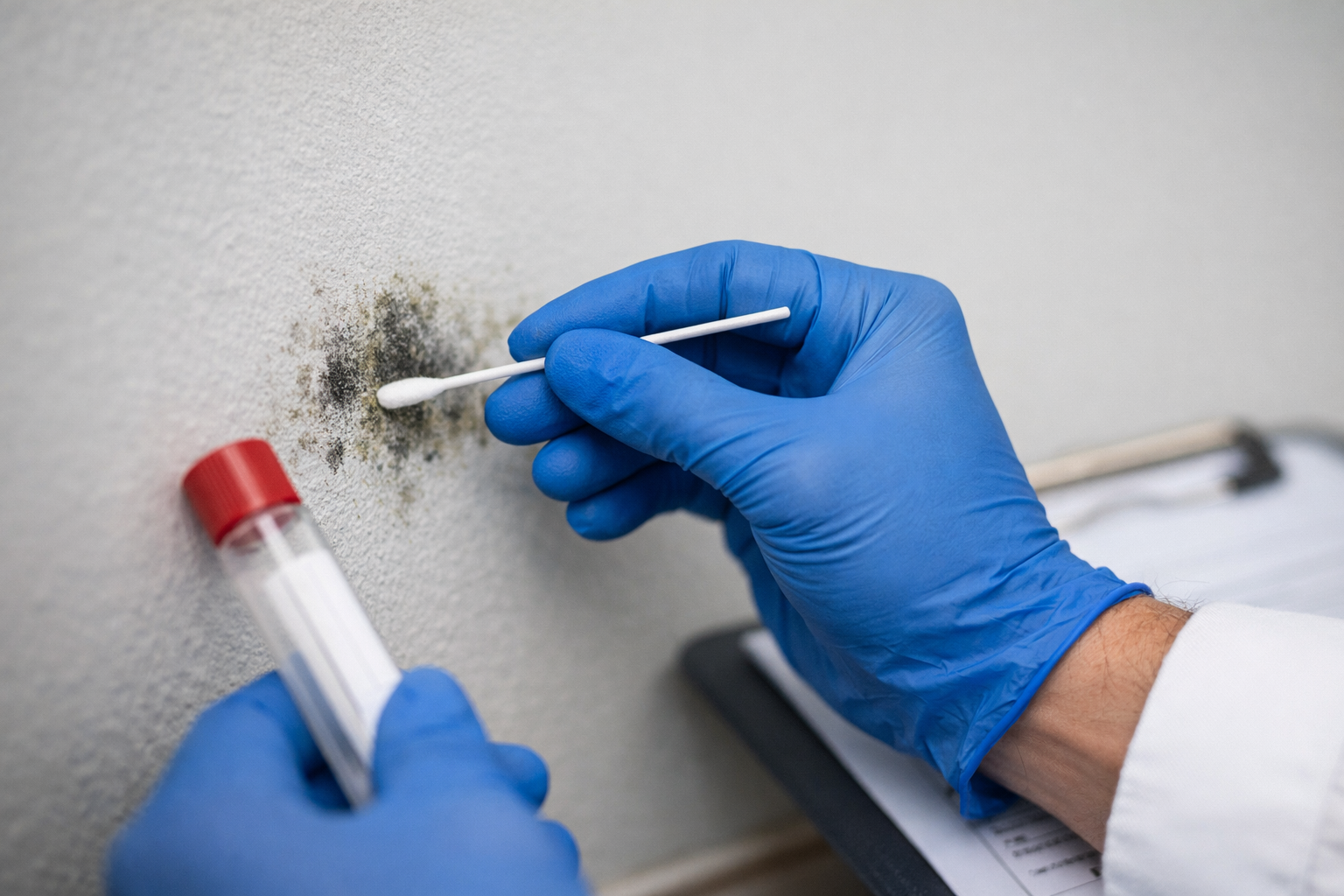
If you can see mold on a wall, vent, ceiling, or piece of furniture, the most common question is:
“Should I do a mold swab test?”
Surface mold testing sounds simple. In some cases, it is. But it only answers very specific questions. Here is what a mold swab test actually tells you, when it makes sense to use one, and where it falls short.
A mold swab test is a type of surface mold testing where a sterile swab is rubbed across visible growth. The sample is sent to a laboratory to identify the mold species present on that exact surface.
It identifies:
It does not identify:
A swab test for mold is a surface identification tool, not a full indoor air quality assessment.
Here are the situations where mold swab testing makes sense.
If mold is clearly visible and the question is: “What type of mold is this?” A surface mold test can answer that. The goal here is species identification, not discovery.
A mold surface sample may be used to evaluate whether visible growth remains on a specific, non-porous surface after cleaning.
This is typically limited to:
It should not replace full post-remediation verification when contamination was extensive.
In some cases, clients already know mold is present but need lab confirmation for legal or financial reasons. A mold swab test provides lab-verified identification tied to a specific location.
Pros of Mold Swab Testing
When used correctly, it answers a narrow question clearly.
Limitations of a Mold Swab Test: It Only Tests the Exact Surface Sampled
If you swab a two-inch area, the lab result applies only to that two-inch area. It does not tell you:
Surface mold testing is highly localized.
A mold swab test does not evaluate what occupants are breathing. Air sampling and dust sampling answer different questions. A surface sample alone cannot assess exposure levels.
Even if the lab reports heavy growth on a mold surface sample, that does not define how widespread the contamination is. You cannot determine full remediation scope from a swab alone.
All mold problems are moisture problems. A swab test identifies organisms, not causes. Without identifying the water source, the mold will return.
Mold Swab Test vs. Air Test: Which Is Better?
This is a common comparison search.
A mold swab test:
Air testing:
They answer different questions. One is not universally better than the other.
When a Mold Swab Test Is Not Enough
Surface mold testing alone is usually not sufficient when:
In those cases, broader investigative methods are typically more appropriate.
Bottom Line: Is a Mold Swab Test Worth It?
A mold swab test is worth it when:
It is not a comprehensive mold investigation. It is one tool in a larger assessment strategy.

.svg)


Texas Department of Licensing and Regulation (TDLR)
Mold Assessment Company: #ACO1327 Exp 09/28
Mold Assessment Consultant: #MAC2207 Exp 11/27
TDLR Consumer Mold Information Sheet
House Of Thyme ® 2026. All Right Reserved.